Use the sliders to see how different crack configurations affect the Bx and Bz signals and the butterfly pattern. Play with depth, length, and speed to build intuition for what the signals are telling you.
ACFM is a type of Non-Destructive Testing (NDT) used to find cracks in metal structures, especially welds. It's commonly used offshore on platforms, pipelines, and vessels.
Think of it like this: ACFM sends an electrical current flowing through the metal surface. When there's a crack, the current has to flow around it — like water flowing around a rock in a stream. The probe measures the resulting disturbance in the magnetic field above the surface, and from those measurements you can determine whether a crack exists, where it is, and how big it is.
ACFM measures two magnetic field components simultaneously. Together they give you the full picture of a crack — both its position and its geometry.
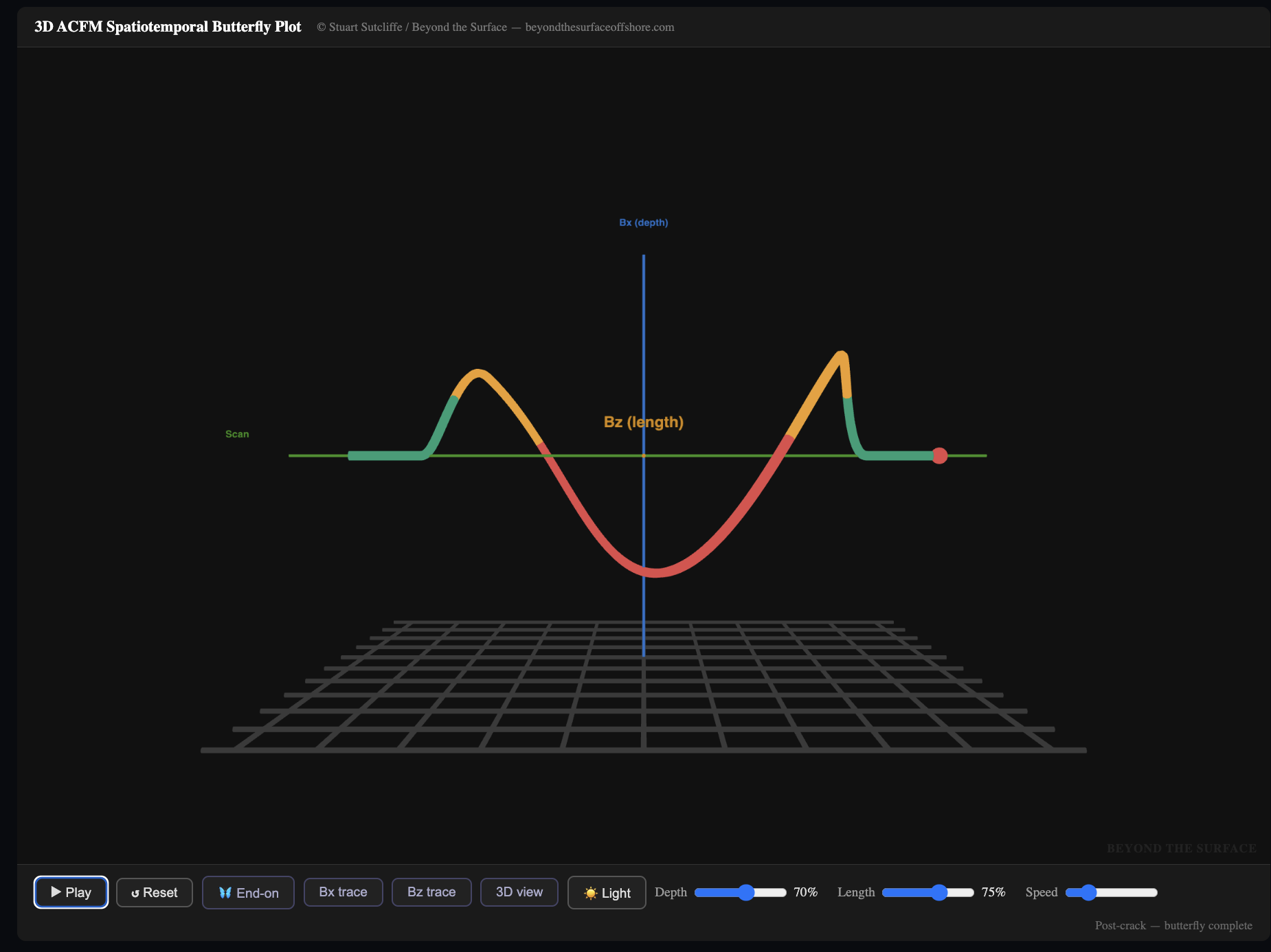
- Bx is parallel to the induced current direction
- The trough corresponds to crack position
- The trough length relates to crack length
Bx measures the magnetic field parallel to the surface and the induced current direction. A crack causes a reduction in this field, producing a distinct trough whose length relates to the crack length.
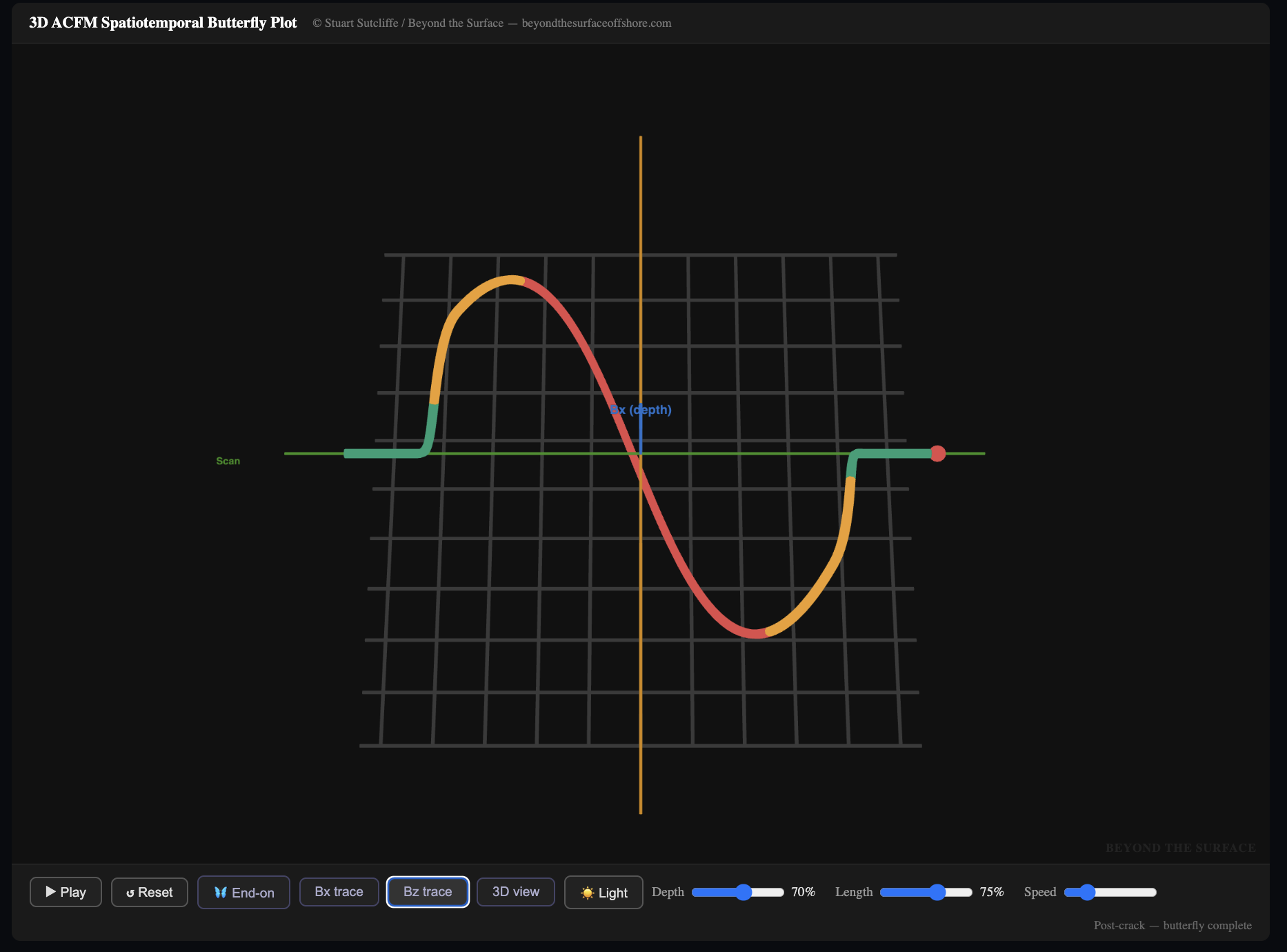
- Measures the magnetic field perpendicular to the surface (up and down)
- Shows a peak and trough around the ends of a crack
- Like measuring how the current gets pushed up and down around the crack
Bz measures the magnetic field perpendicular to the surface. As current flows around the ends of a crack it is deflected upward, creating a characteristic peak-trough pair. The separation between the peak and trough relates to crack length, while the amplitude indicates crack depth.
When you plot Bx against Bz, you get a distinctive "butterfly" shape. This is the key to ACFM — it combines both signal components into a single diagnostic picture.
- No crack = No clear butterfly (just a flat or noisy signal)
- Crack present = Clear butterfly pattern appears
- Longer cracks = wider butterfly
- Deeper cracks = taller butterfly
- Multiple cracks = Multiple butterfly loops
The shape and size of the butterfly tells you about the crack's length and depth. This is why ACFM can size cracks without physical contact with the defect — the geometry of the signal pattern contains the dimensional information.
This makes it ideal for offshore inspections where you need reliable results without extensive surface preparation.